
Watch the video
Is ‘snowmobile’ the wrong word for this? Back when it was built it was called a ‘motor toboggan. Way back when color TVs were only just on sale and this little beauty was in its prime. We were honestly hoping the restoration would be a little more straightforward.
Watch the full video on our YouTube channel.
The machine in question is a 1954 Eliason Motor Toboggan. It had been parked for decades, spending a lot of that time hanging from our rafters. And we were determined to get it running before the day was out.
The Eliason predates the branding, most of the engineering conventions we take for granted, and any reasonable expectation of modern safety features.
No brakes, for instance. The top speed of a machine like this just didn’t warrant the need for any kind of stopping power. The fastest this baby went was almost certainly in the back of a truck.
The throttle is a lever, not a pedal. The shut off is shockingly close to the spark plug wire. The body is plywood or superior lightweight Canadian plywood, to be specific. And it weighs an impressive amount for something built out of wood and old iron. Guess how many of us it took to lift the thing?
A quick walkaround told us most of what we needed to know, and some of it was encouraging.
It was sporting a zip tie pretending to be a dipstick and there was even a little oil hiding in there. That was a good sign. With a little dust off we could actually check the engine. We need to see:
The electrical system didn’t look promising. Wires that appeared melted. Corrosion on everything. The kind of wiring that makes you feel blessed for the decades of innovation that followed. The spark plug itself looked like it belonged to a different era entirely, maybe late 70s or 80s at the earliest. That tells you this machine had already been worked on at some point before it went to sleep.
The diagnostic framework for a 72-year-old engine is the same as any other: spark, air, fuel, compression. You start there and work your way through.
It wasn’t a good start with no spark ❌
We started tracing the electrical system. Corroded wires. Melted-looking insulation. A kill switch that may or may not have been functional at some point in its life. We followed every wire we could find, cleaned the points, scraped off the rust and corrosion, and went back to the spark plug tester.
It fired. Turns out the points just needed a cleanup from some rust, some surface corrosion, nothing catastrophic. For a 72-year-old electrical system, that’s practically a miracle.
With spark sorted, the next task was making fuel flow from the tank into the engine. We took a shortcut by dumping gas directly down the spark plug hole, gave it a shake, and pulled the recoil.
It fired. Forty years of silence, with a little love and throttle it went on our second try.
That confirmed the motor itself was sound. Now we just needed the fuel system to cooperate.
We blew out the tank with an air nozzle, confirmed it had no moisture, and splashed in some race fuel. The tank held gas. For about thirty seconds. Then the fuel leak showed up. The 40-year-old fuel line was done. Cracked, brittle, and it broke in two the moment we touched it. Both pieces, right in our hands.
New fuel line went in. Simple fix.
The engine runs. Fuel is moving. We had momentum. Then the clutch over-centered.
Jammed wide open. The arms had over-entered, and now we had a clutch that wasn’t doing what a clutch is supposed to do. Before we could think about a first ride, we had to fix the arms and get everything back to center.
Once that was sorted, we noticed the belt alignment was off and riding up on the secondary. We weren’t even sure if the belt we had was the correct spec for this machine. Our assessment: it’s close enough. It works. We loosened the motor mounting and adjusted the alignment by hand, which at this point felt entirely appropriate given the technology level we were working with.
We do have a 4,800 square-foot shop with the best tools and the most high-tech race sleds in it. But the second we got 200 feet away from that shop, we were back in 1954. Zip ties, spark plug wires, a hammer and a 9/16 wrench.
Here’s the thing about the first ride. There were no handlebars-only controls. There was no comfortable “this is fine” feeling as we climbed on.
The shutoff situation alone was enough to require a team. You can’t reach the ignition from the riding position. So the solution was simple: one person steers, one person handles the throttle and the ignition. Two people. One motor toboggan. Full commitment.
We made 110 feet before it stopped. Ran out of fuel, so technically not a breakdown, just an operational learning curve. We turned the fuel on and went again.
The choke needed attention. The belt popped off once. But it moved. It picked up speed on the hardpack. The exhaust even does a decent job as a built-in hand dryer if you positioned yourself just right.
At Carl Kuster Mountain Park, we spend every winter on machines that represent the absolute cutting edge of snowmobile engineering. Riding this thing felt like the opposite of that in the best possible way. Completely raw. Completely mechanical. No digital assist, no traction modes, no nothing.
“You know what’s really neat? We have a 4,800 square-foot shop with the best tools and the most high-tech race sleds. And as soon as we get 200 feet from it, it’s like — no, we’re going back to 1954.”
The Eliason isn’t fast. It doesn’t carve. It tips if you look at it wrong.
But there’s something special about giving some love to a snowmobile machine that blazed the path. Seeing it next to the latest in Ski-Doo technology isn’t just hilarious, it’s a perfect demonstration of how far the sport has come.
This motor toboggan is what someone built when they needed to move through the mountains in winter and the options were limited. No technology to lean on. Just ingenuity, plywood, and a small engine. Everything that came after it, every clutch improvement, every track innovation, every chassis redesign, traces back to machines like this one.
We got it running. We rode it. The belt needs a hammer to keep it on track and the shutoff situation remains a two-person operation. But it moves through snow. It fires when you ask it to. And 72 years after someone built it, that still counts for something.
Maybe the Eliason isn’t done yet.
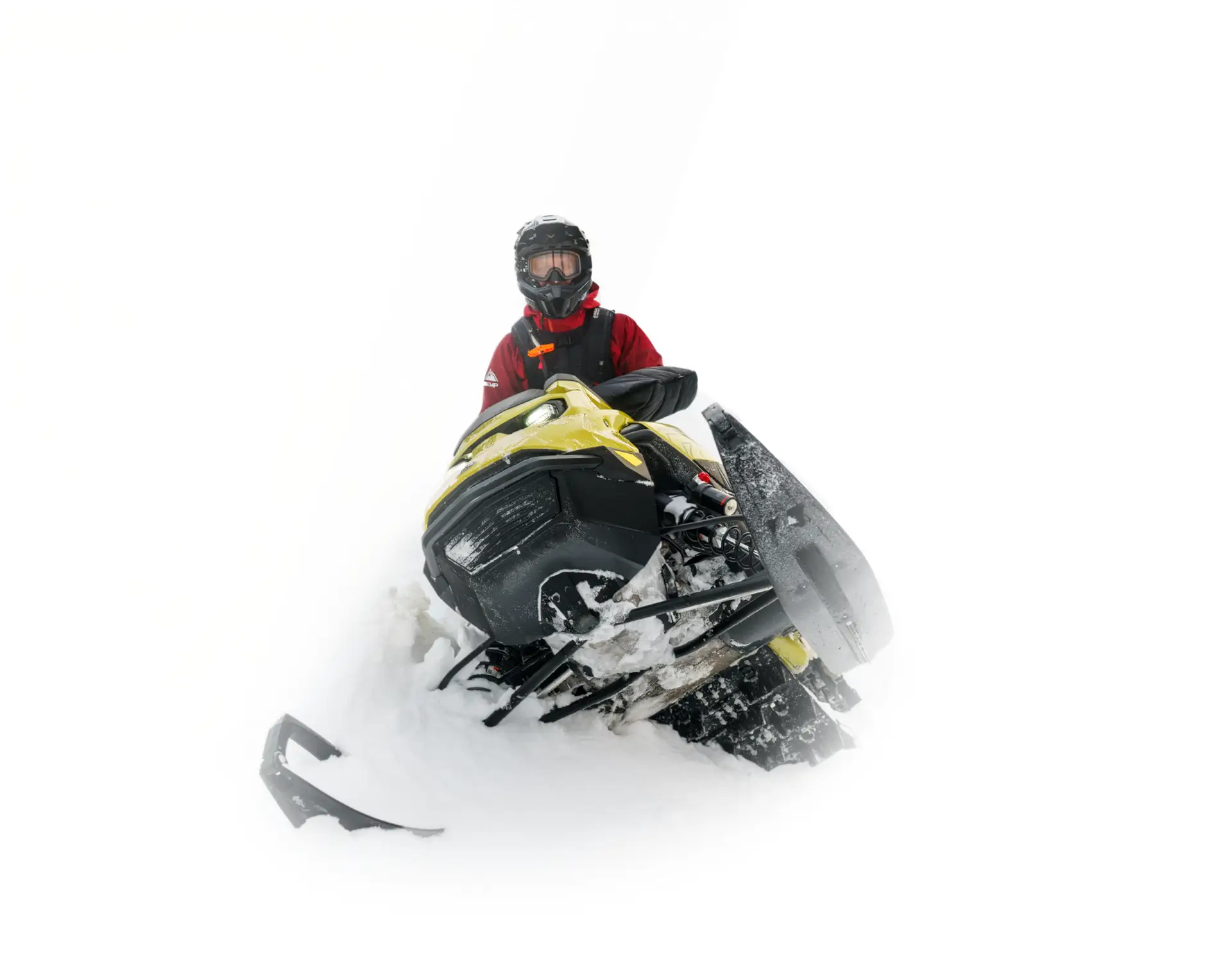
Go deeper into the backcountry and discover hidden pockets of untracked powder with one of our CMBGA certified guides.
For pricing, please refer to our FAQs on ‘Riding Here’.